
Hebrew Niqqud vowels for Aramaic.

Hebrew script for Aramaic.

As I have explained many times the Hebrew alphabet known as ktav ashuri is often used to write Aramaic , Imperial Aramaic, Biblical Aramaic and Judeo-Aramaic dialects mainly.

So,it would be necessary to learn the Hebrew alphabet.


Fff

Development of the Niqqud vowels.

In late Antiquity ,early Medieval Age systems of diacritic dots were devised to denote vowels and teach the correct pronunciation, the so called Niqqud (נִקּוּד) -'diacritics' or Nikud for religious texts in Old Hebrew ,mainly for the Tanakh, the Hebrew Bible.

Due to phonological changes in Modern Hebrew  young Hebrews do not distinguish between the subtle differences that the various diacritics mark.

Here is a table of the Niqqud vowels.


Niqqud schools.

Various dotting systems appeared during Late Antiquity with the most popular being the Tiberian dotting system from the school of Tiberias devised for the Masoretic texts to denote correct vocalization and accent. 

Jewish scholars from the city of Tiberias in Israel under Arab rule came up with a system of diacritics for the correct reading of the Tanakh.

Other notable diacritics systems are the Babylonian Niqqud and Palestinian Niqqud.

Hebrew scribes were obviously inspired by the East Syriac dotting system (Sassanid Syriac) and came up with a similar system of their own for ancient Hebrew texts.

Basic diacritics

niqqud with אאַאֶאֵאִאָאֹאֻאוּ
namepatahseg
ōl
tzerehiriqqamatzholamqubutzshuruq
value/a//ɛ//e//i//ɔ//o//u/


diacriticnamedescriptionhow to read
ַpatahhorizontal line under letterа
ָqamatza «т»  under letterа
ֵtseretwo dots under letters horizontallyэ
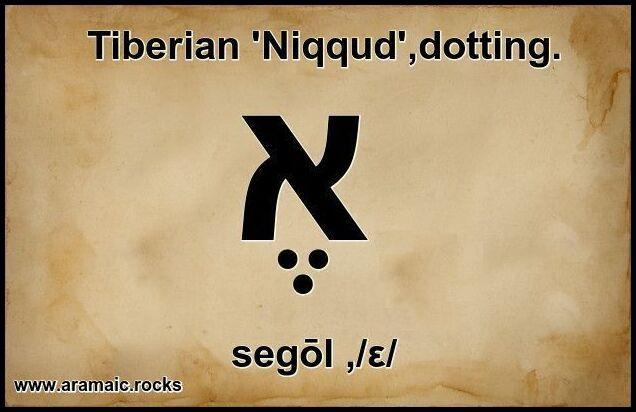
ֶsegōlthree dots under letters like a triangleэ
ִhiriqdot under letterи
י ִhiriq with yoddot under letter followed by yof
ֹholam haserdot over letterо
וֹholam marethe 'waw' letter with a dot aboveо
ָqamatz qatanthe «т» symbol under letter like qumutz, под буквой о
ֻqubbutzthree diagonal dots over lettersу
וּshurukletter 'waw' with a dot on the leftу

Examples

Let's take for example the word 'melek', king in Aramaic.


Here we got three dots, segols,/ɛ/, under the M and L and two dots ,a shewa under the K.


The letter Alef with a segōl underneath.

Read also

Syriac vowels

Comments

Popular posts from this blog

Hebrew Word of the Week: Mammon.

by Yona Sabar Mammon is not in the Bible, where other words are used, such ashon ve-’osher be-veto, “Wealth and riches are in his house” (of the righteous) (Psalms 112:3), but it is very common in (Aramaic),Targumim and rabbinic literature. It may come from ma’mon “trust, deposit.” In Christianity, however, Mammon* has been associated with covetousness of wealth, the seventh sin (Matthew 6:24: You cannot serve God and mammon). In modern Hebrew, mamon is quite common with regard to financial and property business, such as mimmen, “financed”; mimmun, “financing”; mamonay, “financier”; mamoni, “monetary”; anddine’ mamonot, “civil (property) laws.” *Some Hebrew-Aramaic names and nouns entered English (via Latin-Greek), from the New Testament, such as Thomas, “twin (brother)” and abba, “father.” Yona Sabar is a professor of Hebrew and Aramaic in the department of Near Eastern Languages & Cultures at UCLA. Article found here .

What's your name in Aramaic.

What's your name in Aramaic. Ancient Aramaic ?מה שׁמך  שׁמי ישׁוע Mah shmakh? (m) What is your name?   ישוע שמי Shmi Yeshua My name is Jesus. מא שמיך ma shmikh (f) What's your name? when talking to a female. Classical Syriac ܡ݃ܗ ܫܡ݃ܟ Mah shmak? ܝܶܫܽܘܥ ܫܡܝ݈ yeshuwʿ shmy݈ My name is Jesus. Neo-Aramaic Sureth (Assyrian Neo-Aramaic) ܡܼܘܕܝܼ ܝܠܸܐ ܫܸܡܘܼܟ Mude le shimukh? What's your name? Other  ܡܢ ܫܡܐ ܕܠܟ  ܫܡܐ ܕܠ ܝܗ ܗܘ man shmo dlokh? Shmo dil Yshu’a haw What's your name? My name is Jesus. Back to short Aramaic lessons. Read also Greetings in Ancient Aramaic . Some Aramaic greetings .

Jesus in Aramaic.

Jesus Christ, also known as Jesus of Nazareth, is believed by many scholars to have spoken Aramaic as his native language. Aramaic was a common language in the region of Galilee where Jesus grew up, and it was also used as a lingua franca throughout the Near East during the time of Jesus. There are several Aramaic words and phrases that are attributed to Jesus in the New Testament, such as "Talitha koum" (which means "Little girl, I say to you, get up!") and "Eli, Eli, lema sabachthani?" (which means "My God, my God, why have you forsaken me?"). These phrases are evidence of Jesus' use of Aramaic. Additionally, some scholars believe that certain sayings of Jesus in the New Testament may have been originally spoken in Aramaic and later translated into Greek. For example, the saying "You cannot serve both God and money" (Matthew 6:24) is thought by some scholars to have originally been spoken in Aramaic as "You cannot serve both...