
Syriac diacritics (ptaha)

zqafa-alaf

I. In addition to the vowel zqafa and the combination zqafa-alaf ,the vowel [a] can be indicated with the vowel ptaha which has the following form:


As you can clearly see, this vocalization schematically reproduces the letter A of the Greek alphabet.

II. The ptaha diacritic marks the [а] sound which was a short vowel at an earlier stage of the language. Classical Syriac had no distinction between short and long vowels. So the diacritics ptaha and zqofo mark the same sound-[a].


A general rule to remember is that closed syllables- those ending in a consonant take a ptaha while open syllables- those ending in a vowel take a zqafa.


A syllable in Syriac cannot have more than one vowel and cannot begin with more than two consonants.


For example in the word bav-ga, the first syllable is closed and therefore ptaha is used. The second syllable is open so the [a] sound is marked with a zqafa.

bav-ga

In some words , loanwords mainly an alaf is used after ptaha as in the word Bagdad.


Bagdad

 
III. In some cases, for example the word gada, the letter that follows the combination gamal-ptaha ,the dalat takes a zqafa. That makes the syllable with the gamal open - GAda.
gada

In such cases the open syllable is closed with the doubling of the following consonant (gemination), dalata in this case and the word is pronounced gadda.

Compare the following variation of the word ,in which the zqafa over the gamal does not require an open syllable ,so there is no need to double the dalat.
gada (with a zqafa over the gamal)

Gemination of consonants is not observed in the traditional way of the Yakobite and Maronite way of reading. 

Accordingly, the following word will read gado

  While the word below will read godo.

(for reading the zqafa as [o] see the footnote in paragraph

In the example above the consonant d changes to d after the gemination  because occlusive-aspirated consonants are geminated only in their occlusive variant (bb,gg,dd). The variants vv,gg,dd are excluded.

 In the Syriac language there's no diacritic for gemination, nevertheless the kushaya (dot above) may indicate gemination.
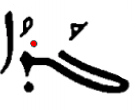
The red dot above the d
 indicates gemination.


The rules above are not absolute and have numerous exceptions. For example the alaf  at he beginning of the word usually takes a ptaha above. Nevertheless the following consonant many not be geminated.
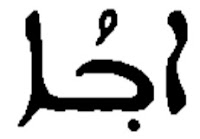
a-va


Read also
Forms of Alaph


Comments

Popular posts from this blog

Hebrew Word of the Week: Mammon.

by Yona Sabar Mammon is not in the Bible, where other words are used, such ashon ve-’osher be-veto, “Wealth and riches are in his house” (of the righteous) (Psalms 112:3), but it is very common in (Aramaic),Targumim and rabbinic literature. It may come from ma’mon “trust, deposit.” In Christianity, however, Mammon* has been associated with covetousness of wealth, the seventh sin (Matthew 6:24: You cannot serve God and mammon). In modern Hebrew, mamon is quite common with regard to financial and property business, such as mimmen, “financed”; mimmun, “financing”; mamonay, “financier”; mamoni, “monetary”; anddine’ mamonot, “civil (property) laws.” *Some Hebrew-Aramaic names and nouns entered English (via Latin-Greek), from the New Testament, such as Thomas, “twin (brother)” and abba, “father.” Yona Sabar is a professor of Hebrew and Aramaic in the department of Near Eastern Languages & Cultures at UCLA. Article found here .

What's your name in Aramaic.

What's your name in Aramaic. Ancient Aramaic ?מה שׁמך  שׁמי ישׁוע Mah shmakh? (m) What is your name?   ישוע שמי Shmi Yeshua My name is Jesus. מא שמיך ma shmikh (f) What's your name? when talking to a female. Classical Syriac ܡ݃ܗ ܫܡ݃ܟ Mah shmak? ܝܶܫܽܘܥ ܫܡܝ݈ yeshuwʿ shmy݈ My name is Jesus. Neo-Aramaic Sureth (Assyrian Neo-Aramaic) ܡܼܘܕܝܼ ܝܠܸܐ ܫܸܡܘܼܟ Mude le shimukh? What's your name? Other  ܡܢ ܫܡܐ ܕܠܟ  ܫܡܐ ܕܠ ܝܗ ܗܘ man shmo dlokh? Shmo dil Yshu’a haw What's your name? My name is Jesus. Back to short Aramaic lessons. Read also Greetings in Ancient Aramaic . Some Aramaic greetings .

Jesus in Aramaic.

Jesus Christ, also known as Jesus of Nazareth, is believed by many scholars to have spoken Aramaic as his native language. Aramaic was a common language in the region of Galilee where Jesus grew up, and it was also used as a lingua franca throughout the Near East during the time of Jesus. There are several Aramaic words and phrases that are attributed to Jesus in the New Testament, such as "Talitha koum" (which means "Little girl, I say to you, get up!") and "Eli, Eli, lema sabachthani?" (which means "My God, my God, why have you forsaken me?"). These phrases are evidence of Jesus' use of Aramaic. Additionally, some scholars believe that certain sayings of Jesus in the New Testament may have been originally spoken in Aramaic and later translated into Greek. For example, the saying "You cannot serve both God and money" (Matthew 6:24) is thought by some scholars to have originally been spoken in Aramaic as "You cannot serve both...